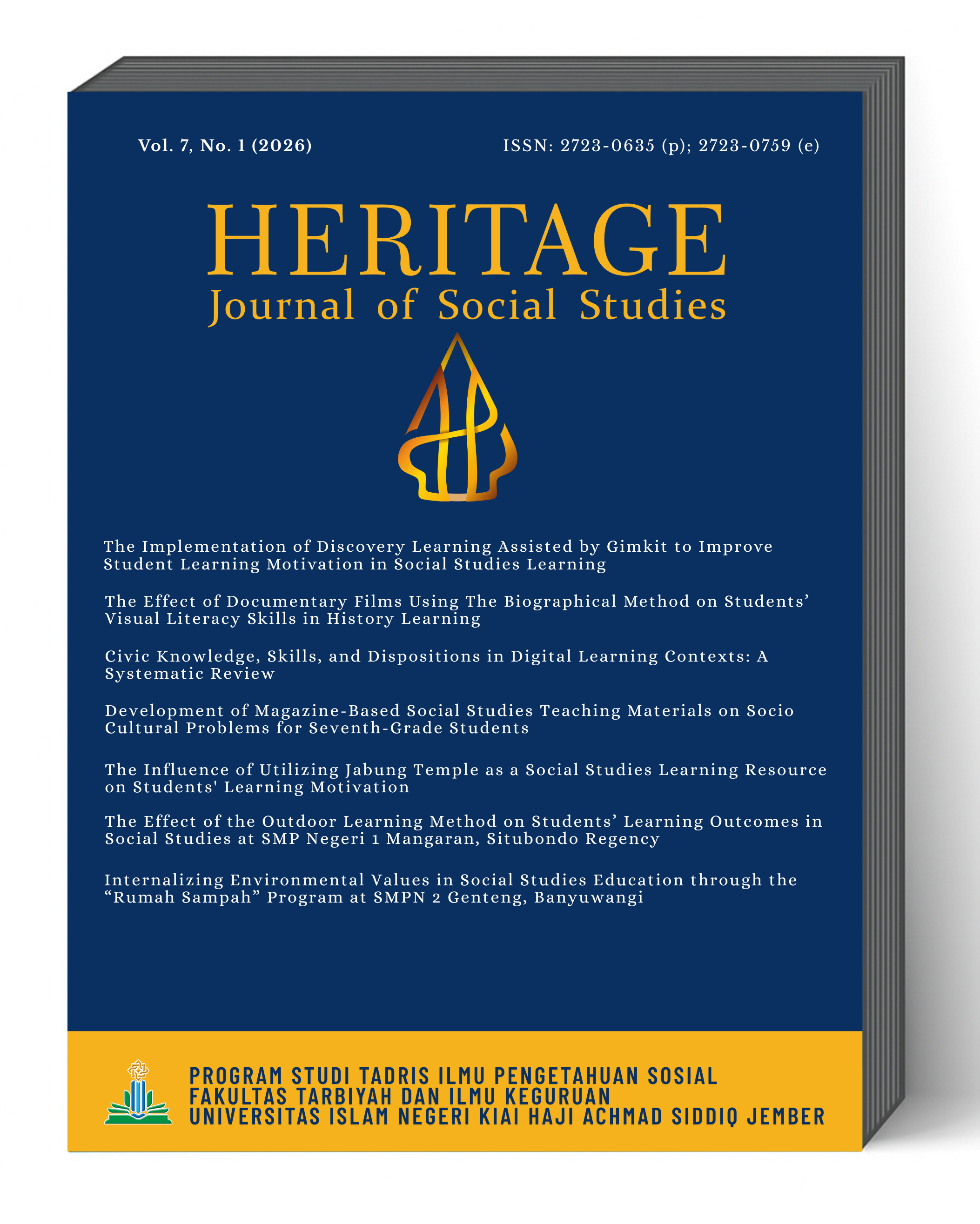
Civic Knowledge, Skills, and Dispositions in Digital Learning Contexts: A Systematic Review
DOI:
https://doi.org/10.35719/hrtg.v7i1.210Keywords:
civic education, digital learning, online education, civic competencies, systematic reviewAbstract
Digital technologies have transformed how students develop civic competencies in higher education. This systematic review synthesizes empirical evidence on civic learning outcomes across digital platforms and identifies digital learning modalities that most effectively foster civic knowledge, skills, and dispositions. Following PRISMA guidelines, 58 peer-reviewed articles (2014–2024) from Scopus, Web of Science, and ERIC were analyzed using narrative thematic synthesis and effect size comparison (Cohen's d). Interactive digital modalities, including online discussions, simulations, and collaborative platforms, produced moderate to large effects (d = 0.48–1.12) on civic skills and dispositions, whereas content-delivery approaches showed only small effects (d = 0.18–0.43), primarily on knowledge acquisition. However, most studies relied on self-reported outcomes measured within four weeks, with considerable methodological heterogeneity and frequent use of non-validated instruments, limiting conclusions about long-term behavioral change. Three civic competency domains emerged: cognitive, participatory, and affective. The review highlights that the effectiveness of digital learning depends more on interaction design than on technology type, with student-to-student and student-to-content interactions serving as stronger predictors of civic learning outcomes than specific digital platforms.
References
Abubakari, M. S., Abdul Nasir Zakaria, G., Priyanto, P., & Triantini, D. T. (2023). Analysing technology acceptance for digital learning in Islamic education: the role of religious perspective on ICT. Journal of Computing Research and Innovation, 8(1), 1–16. https://doi.org/10.24191/jcrinn.v8i1.344
Achmad Faruk, A., Suherman, D., Mudrikah, A., & Mulyanto, A. (2022). Management Of Character Education To Improve The Quality Of Education In Islamic Boarding School (Qualitative Study at Cipasung Islamic Boarding School and KH Zaenal Mustofa Sukamanah Islamic Boarding School in Tasikmalaya Regency). International Journal of Educational Research & Social Sciences, 3(5), 1851–1861. https://doi.org/10.51601/ijersc.v3i5.482
Aimah, S., Rukmini, D., Saleh, M., & Bharati, D. A. L. (2020). Microteaching guided by an expert secondary english teacher: The effect on pre-service english teachers’ pedagogical content knowledge. Pedagogika, 139(3), 111–135. https://doi.org/10.15823/p.2020.139.6
Akbar, T. K., & Suyadi. (2021). Desain Pembelajaran Pendidikan Islam Berbasis Neurosains : Peran. 13(1), 94–118.
Alscher, P., Ludewig, U., & McElvany, N. (2022). Civic education, teaching quality and students’ willingness to participate in political and civic life: Political interest and knowledge as mediators. Journal of Youth and Adolescence, 51(10), 1886–1900. https://doi.org/https://doi.org/10.1007/s10964-022-01639-9
Andiwatir, A., Nay, F. A., & Talan, R. (2021). Model Pembelajaran SCL ( Student Center Learning ) pada Siswa Lamban Belajar ( Slow Learner ) Sekolah Menengah Pertama. PEMBELAJAR : Jurnal Ilmu Pendidikan, Keguruan, Dan Pembelajaran, 05(02), 117–122.
Aswad, N. G. (2019). Exploring Charismatic Leadership: A Comparative Analysis of the Rhetoric of Hillary Clinton and Donald Trump in the 2016 Presidential Election. Presidential Studies Quarterly, 49(1), 56–74. https://doi.org/10.1111/PSQ.12490
Ayertei, T. G. (2018). Effects of Classroom Attendance and Learning Strategies on the Learning Outcome. Journal of International Education in Business, 11(2), 195–219. https://doi.org/10.1108/JIEB-01-2017-0004
Barikzai, S., Bharathi S, V., & Perdana, A. (2024). Challenges and strategies in e-learning adoption in emerging economies: a scoping review. Cogent Education, 11(1), 2400415. https://doi.org/10.1080/2331186X.2024.2400415
Batool, S., Izwar Ibrahim, H., & Adeel, A. (2024). How responsible leadership pays off: Role of organizational identification and organizational culture for creative idea sharing. Sustainable Technology and Entrepreneurship, 3(2), 100057. https://doi.org/10.1016/j.stae.2023.100057
Biesta, G. (2014). Learning in Public Places: Civic Learning for the Twenty-First Century. In Civic Learning, Democratic Citizenship and the Public Sphere (pp. 1–11). Springer Netherlands. https://doi.org/10.1007/978-94-007-7259-5_1
Dinia, A. G., Wiguna, C., & Burhanudin, A. (2022). Sistem Pengukuran Kualitas Website Penelitian dan Pengabdian Masyarakat I-Gracias Menggunakan Metode Webqual. Jurnal Teknik Informatika Dan Sistem Informasi, 8(1), 1–11. https://doi.org/10.28932/jutisi.v8i1.3915
Elhefni, E., Alihawanah, Syarifuddin, A., Handayani, T., Nurlaeli, Hamzah, A., Husni, M., Dwi Saputra, A., Safitri, R., & Fadhilah, D. P. A. (2024). Penguatan Moderasi Beragama Melalui Nilai-Nilai Pendidikan Islam Dalam Kearifan Lokal Sedekah Pedusunan. TAAWUN, 4(01), 66–77. https://doi.org/10.37850/taawun.v4i01.596
Eriza Zuhry, F., Aulia, H., Nasywa Zulfita, Rouli Margaretha, Matang, M., & Lham Hudi. (2024). Civic Education Efforts in Cultural Aspects for the Formation of Student Identity. Jurnal Edukasi Terkini, 1(1), 1–7. https://doi.org/10.70310/hgjvq985
Exintaris, B., Karunaratne, N., & Yuriev, E. (2023). Metacognition and critical thinking: using ChatGPT-generated responses as prompts for critique in a problem-solving workshop (SMARTCHEMPer). J. Chem. Educ., 100(8), 2972.
Farrokhnia, M., Banihashem, S. K., Noroozi, O., & Wals, A. (2023). A SWOT analysis of ChatGPT: implications for educational practice and research. Innovations in Education and Teaching International, 1.
Foster, J., & Yaoyuneyong, G. (2016). Teaching innovation: Equipping students to overcome real-world challenges. Higher Education Pedagogies, 1(1), 42–56. https://doi.org/10.1080/23752696.2015.1134195
Fries, A., Kammerlander, N., & Leitterstorf, M. (2021). Leadership styles and leadership behaviors in family firms: A systematic literature review. Journal of Family Business Strategy, 12(1), 100374.
Haryanto, Z., Sulaeman, N. F., Nuryadin, A., Putra, P. D. A., Putri, S. A., & Rahmawati, A. Z. (2021). Learning how to plan a science lesson: An exploration of preservice science teacher reflection in online microteaching. Journal of Physics: Conference Series, 2104(1). https://doi.org/10.1088/1742-6596/2104/1/012017
Hidayatullah, & Setiawan, B. (2024). Empowering students’ collaborative skills sustainability by utilizing problem-based learning as an instructional strategy in online learning. Cogent Education, 11(1), 2362006.
Hoggan-Kloubert, T., & Mabrey, P. E. (2022). Civic Education as Transformative Education. Journal of Transformative Education, 20(3), 167–175. https://doi.org/10.1177/15413446221103173
Hwang, G.-J., & Chang, C.-Y. (2023). A review of opportunities and challenges of chatbots in education. Interactive Learning Environments, 31, 4099.
Joosten, T., & Cusatis, R. (2020). Online Learning Readiness. American Journal of Distance Education, 1–14.
Kadiwone, L. L., Dharmawibawa, I. D., & Utami, S. D. (2022). Penerapan Model Pembelajaran Inquiry Based Learning untuk Meningkatkan Aktivitas dan Hasil Belajar Kognitif Siswa. Bioscientist: Jurnal Ilmiah Biologi, 10(1), 1–9.
Landrum, B., Bannister, J., Garza, G., & Rhame, S. (2020). A class of one: Students’ satisfaction with online learning. Journal of Education for Business, 1–7.
Liu, Y., Chen, L., & Yao, Z. (2022). The application of artificial intelligence assistant to deep learning in teachers’ teaching and students’ learning processes. Frontiers in Psychology, 13, 929175. https://doi.org/10.3389/fpsyg.2022.929175
Liu, Z.-Y., Lomovtseva, N., & Korobeynikova, E. (2020). Online learning platforms: Reconstructing modern higher education. International Journal of Emerging Technologies in Learning (IJET), 15(13), 4–21.
Marcia, D., & Jade, M. (2019). A “Critical Factor”: Facilitating the Success of Students from Low Socioeconomic Status Backgrounds at Australian Regional Universities Through Technology. In J. Hoffman, P. Blessinger, & M. Makhanya (Eds.), Strategies for Facilitating Inclusive Campuses in Higher Education: International Perspectives on Equity and Inclusion (Vol. 17, pp. 131–144). Emerald Publishing Limited. https://doi.org/10.1108/S2055-364120190000017010
Miftakhu Rosyad, A., & Mahamood, S. F. (2026). A Systematic Literature Review of Pancasila Education in Higher Education: Trends, Pedagogical Innovations, and Learner Competencies. International Journal of Science Education and Cultural Studies, 4(2), 28–46. https://doi.org/10.58291/ijsecs.v4i2.459
Naval, C., Villacís, J. L., & Ibarrola-García, S. (2022). The Transversality of Civic Learning as the Basis for Development in the University. Education Sciences, 12(4), 240. https://doi.org/10.3390/educsci12040240
Pradipa, R., Nurchamidah, N., Safingah, K., Hamsah, M., & Rosyad, A. M. (2025). Investigation of Learning Loss in the Students’ Skills Competency Domain in Islamic Religious Education Subjects at Muhammadiyah Jogokariyan Elementary SchoolInvestigation of Learning Loss in the Students’ Skills Competency Domain in Islamic Religious Edu. SALIHA: Jurnal Pendidikan Islam, 8(1), 32–51.
Romli, M. H., Wan Yunus, F., Cheema, M. S., Abdul Hamid, H., Mehat, M. Z., Md Hashim, N. F., Foong, C. C., Hong, W.-H., & Jaafar, M. H. (2022). A Meta-synthesis on Technology-Based Learning Among Healthcare Students in Southeast Asia. Medical Science Educator, 32(3), 657–677. https://doi.org/10.1007/s40670-022-01564-3
Rosyad, A. M., & Khoiriyah, A. (2025). Integrasi Nilai-Nilai Islam dalam Pembelajaran Pendidikan Kewarganegaraan: Systematical Literature Review. Journal Islamic Pedagogia, 5(2), 110–124. https://doi.org/https://doi.org/10.31943/pedagogia.v5i2.145
Rosyad, A. M., Suhendrik, S., Faozi, R., Nurchamidah, N., & Hamsah, M. (2024). Pelaksanaan Kurikulum Merdeka Belajar di Sekolah Menengah Kejuruan. Berkala Ilmiah Pendidikan, 4(3 SE-Articles), 712–723. https://doi.org/10.51214/bip.v4i3.1255
Santhosh, K. S., Sumathi, M., Hanumanthappa, J., & Santhosh, K. S. (2025). ScienceDirect IoT-based E ffi cient Waste on Management on Campus : E ffi cient Waste Management through on University Campus Enhancing Monitoring and Optimization Machine Learning Enhancing Monitoring and J . Optimization Machine Learning. Procedia Computer Science, 258, 4157–4168. https://doi.org/10.1016/j.procs.2025.04.666
Soleh, A. R., & Arifin, Z. (2021). Integrasi Keterampilan Abad 21 dalam Pengembangan Perangkat Pembelajaran Pada Konsep Community of Inquiry. QALAMUNA: Jurnal Pendidikan, Sosial, Dan Agama, 13(2), 473–490. https://doi.org/10.37680/qalamuna.v13i2.995
Spindler, R. (2019). Aligning Modeling Projects with Bloom’s Taxonomy. Primus, 0(0), 1–16. https://doi.org/10.1080/10511970.2019.1619208
Stokamer, S. T., & Clayton, P. H. (2023). Student civic learning through service learning: Instructional design and research. In Research on student civic outcomes in service learning (pp. 45–66). Routledge.
Suyadi, S. (2022). Type developing an Islamic education curriculum on outcomes-based education as a defensive strategy facing the challenges of industry revolution 4.0. International Journal of Education and Learning, 4(1), 41–57.
Taylor, J. K., & Rouillard, J. (2021). Roots and progress: A review of civic learning and democratic engagement on college campuses. New Directions for Higher Education, 2021(195–196), 107–113. https://doi.org/10.1002/he.20414
Ufua, D. E., Salau, O. P., Ikpefan, O., Dirisu, J. I., & Okoh, E. E. (2020). Addressing operational complexities through re-inventing leadership style: A systemic leadership intervention. Heliyon, 6(7), e04270. https://doi.org/10.1016/j.heliyon.2020.e04270
Wang, H.-H., Lin, H., Chen, Y.-C., Pan, Y.-T., & Hong, Z.-R. (2021). Modelling relationships among students’ inquiry-related learning activities, enjoyment of learning, and their intended choice of a future STEM career. International Journal of Science Education, 43(1), 157–178.
Watson, L. (2019). Educating for inquisitiveness: A case against exemplarism for intellectual character education. Journal of Moral Education, 48(3). https://doi.org/10.1080/03057240.2019.1589436
Widiatmaka, P., & Kurniawan, I. D. (2023). Peningkatan Civic Literasi dengan Memanfaatkan Literasi Digital Melalui Pendidikan Kewarganegaraan di Perguruan Tinggi. Jurnal Pekommas, 8(1), 59–70.
Xiao, Yu, & Watson, Maria. (2017). Guidance on Conducting a Systematic Literature Review. Journal of Planning Education and Research, 39(1), 93–112. https://doi.org/10.1177/0739456X17723971
Zhao, Y., Pinto Llorente, A. M., & Sánchez Gómez, M. C. (2021). Digital competence in higher education research: A systematic literature review. Computers & Education, 168, 104212. https://doi.org/https://doi.org/10.1016/j.compedu.2021.104212
Zulyusri, Z., Elfira, I., Lufri, L., & Santosa, T. A. (2023). Literature Study: Utilization of the PjBL Model in Science Education to Improve Creativity and Critical Thinking Skills. Jurnal Penelitian Pendidikan IPA, 9(1), 133–143. https://doi.org/10.29303/jppipa.v9i1.2555
Downloads
Published
How to Cite
Issue
Section
License
Copyright (c) 2026 Ali Miftakhu Rosyad

This work is licensed under a Creative Commons Attribution-ShareAlike 4.0 International License.