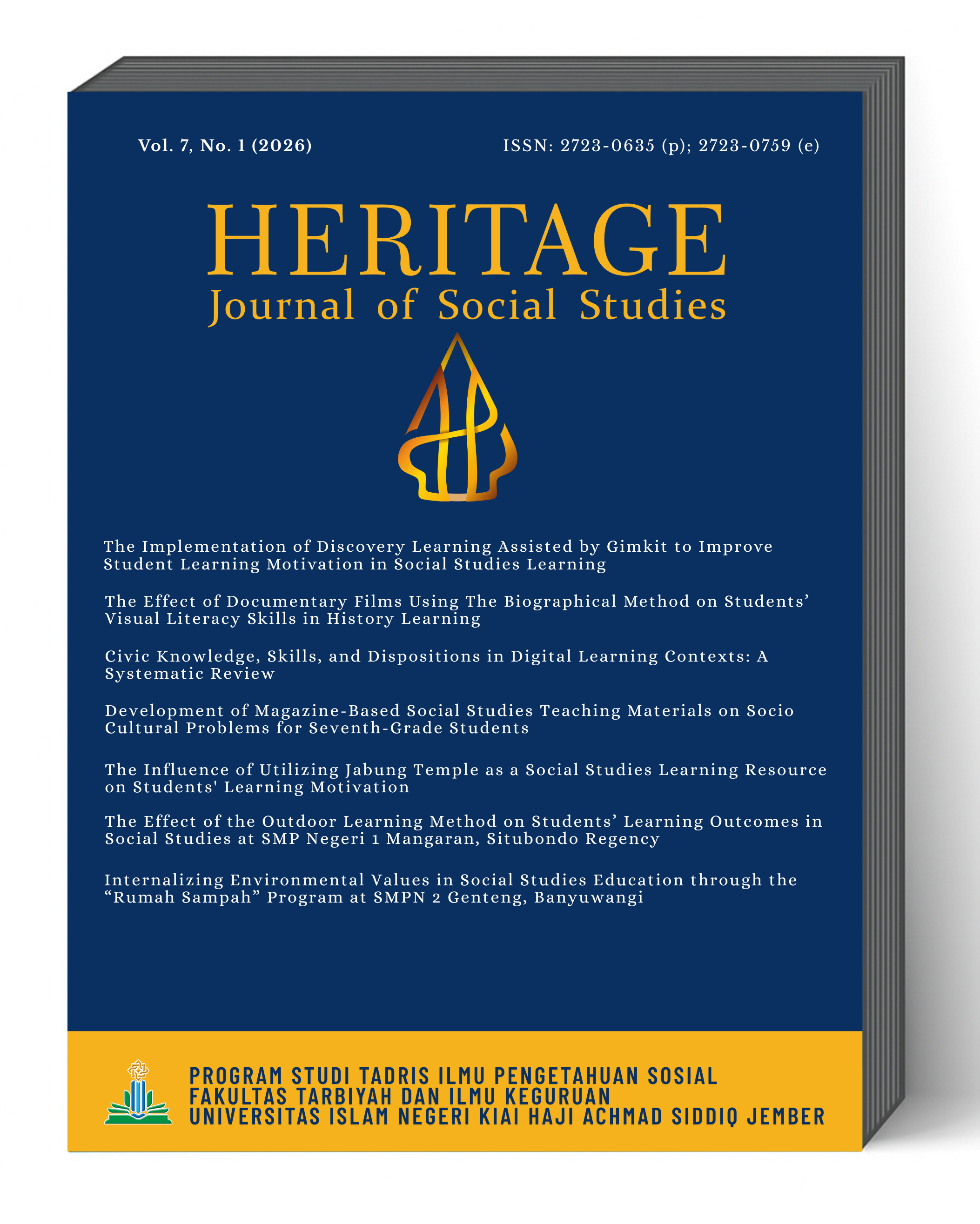
The Influence of Utilizing Jabung Temple as a Social Studies Learning Resource on Students' Learning Motivation
DOI:
https://doi.org/10.35719/hrtg.v7i1.221Keywords:
learning motivation, learning resources, social studies, historical site, contextual learningAbstract
This study aims to examine the effect of utilizing Jabung Temple as a Social Studies learning resource on students' learning motivation. The study was motivated by students' low learning motivation due to limited learning resources and a lack of contextual learning experiences. Previous studies have mainly focused on classroom instructional media, while the use of local historical sites as contextual learning resources in Social Studies remains underexplored. This study employed a quantitative approach using a quasi-experimental method with a nonequivalent control group design. The population consisted of 58 eighth-grade students at SMP Negeri 2 Paiton, Probolinggo, divided into an experimental group (n = 29) and a control group (n = 29). The experimental group participated in contextual learning through Jabung Temple, including site observation, exploration of historical values, and guided learning activities, while the control group received conventional classroom instruction. Data were collected using a learning motivation questionnaire and analyzed with the Independent Samples t-test in SPSS version 27. The experimental group achieved a higher mean motivation score (M = 53.86, SD = 3.079) than the control group (M = 51.97, SD = 2.784). The hypothesis test revealed a significant difference between the groups (t(56) = -2.461, p = .017), with a Cohen's d of 0.65, indicating a moderate effect. These findings suggest that integrating Jabung Temple as a local historical learning resource provides authentic learning experiences, enhances student engagement, and effectively improves learning motivation in Social Studies.
References
Abidinsyah, Siti Ramdiah, & Muhammad Royani. (2019). The implementation of local wisdom-based learning and HOTS-based assessment: Teacher survey in Banjarmasin. JPBI (Jurnal Pendidikan Biologi Indonesia), 5(3), 407–414. https://doi.org/10.22219/jpbi.v5i3.9910
Ajeng Eka Prastuti, Sarmini, & Nugroho Hari Purnomo. (2020). Implementation of contextual teaching and learning social sciences subjects to increase motivation and learning achievement. The Indonesian Journal of Social Studies, 3(2), 67–73. https://doi.org/10.26740/ijss.v3n2.p67-73
Aman. (2011). Pengembangan model evaluasi pembelajaran sejarah. Yogyakarta: UNY Press.
Anwar. (2018). Implementasi model pembelajaran terpadu di SDI Darush Sholihin Kecamatan Tanjunganom Kabupaten Nganjuk. Intelektual: Jurnal Pendidikan dan Studi Keislaman, 8(2), 241–250. https://doi.org/10.33367/ji.v8i2.715
Arikunto, S. (2013). Prosedur penelitian: Suatu pendekatan praktik. Jakarta: Rineka Cipta.
Damanik, T., Sihotang, H., & Sinaga, R. (2023). Utilization of school libraries as learning resources to improve student learning outcomes. Journal on Education, 5(4), 14225–14230. https://doi.org/10.31004/joe.v5i4.2444
Dewi, A. E. R., & Alam, A. A. (2021). The effect of contextual teaching and learning approach and learning creativity on student learning outcomes. Journal of Educational Science and Technology (EST), 7(3), 261–268. https://doi.org/10.26858/est.v7i3.24675
Fikri, A. (2019). Pemanfaatan Candi Muara Takus sebagai sumber belajar dalam pembelajaran sejarah di SMA Darmayudha Pekanbaru. HISTORIKA, 22(1), 71–83. https://doi.org/10.20961/historika.v22i1.29340
Fredricks J. A., Blumenfeld, P. C., & Paris, A. H. (2004). School engagement: Potential of the concept, state of the evidence. Review of Educational Research, 74(1), 59–109. https://doi.org/10.3102/00346543074001059
Hamalik, O. (2014). Proses belajar mengajar. Jakarta: Bumi Aksara.
Harefa, D., Telaumbanua, T., Gee, E., Ndruru, M., & Hulu, F. (2022). Pengaruh model pembelajaran cooperative learning terhadap hasil belajar siswa. Jurnal Basicedu, 6(4), 6808–6815. https://doi.org/10.31004/basicedu.v6i4.3301
Isnaini, D., Larasati, D. A., Prasetyo, K., & Nasution. (2022). Pengaruh pemanfaatan Museum Mpu Tantular sebagai sumber belajar IPS terhadap peningkatan hasil belajar sejarah siswa. Dialektika Pendidikan IPS, 2(2), 327–334. https://ejournal.unesa.ac.id/index.php/PENIPS/article/view/48836
Johnson, E. B. (2002). Contextual teaching and learning: What it is and why it’s here to stay. California: Corwin Press.
Lestari, N. I., Rachmedita, V., & Sinaga, R. M. (2024). Efektifitas penggunaan bahan ajar situs sejarah lokal Lampung untuk meningkatkan hasil belajar mahasiswa. Estoria: Journal of Social Science and Humanities, 4(2), 653–663. https://doi.org/10.30998/je.v4i2.2773
Majid, A. (2014). Strategi pembelajaran. Bandung: Remaja Rosdakarya.
Minsih, M. (2018). Peran guru dalam pengelolaan kelas. Jurnal Basicedu, 2(1), 20–27. https://doi.org/10.31004/basicedu.v2i1.23
Misnah. (2019). Pengaruh media pembelajaran Situs Lumpang Batu dan motivasi belajar siswa terhadap hasil belajar sejarah siswa SMA. JTP–Jurnal Teknologi Pendidikan, 21(1), 42–55. https://doi.org/10.21009/jtp.v21i1.10520
Nasution, S. (2012). Berbagai pendekatan dalam proses belajar mengajar. Jakarta: Bumi Aksara.
Pane, A., & Dasopang, M. D. (2017). Belajar dan pembelajaran. FITRAH Jurnal Kajian Ilmu-ilmu Keislaman, 3(2), 333–352. https://doi.org/10.24952/fitrah.v3i2.945
Piaget, J. (1954). The construction of reality in the child. New York: Basic Books.
Puspita, I., Indarti, N., & Nurhayati, D. (2023). Pendekatan, metode, strategi dan model pembelajaran: Literature review. Jurnal Equilibrium Nusantara, 2(1). https://doi.org/10.56854/jeqn.v2i1.150
Sanjaya, W. (2016). Strategi pembelajaran berorientasi standar proses pendidikan. Jakarta: Kencana.
Sardiman. (2014). Interaksi dan motivasi belajar mengajar. Jakarta: Raja Grafindo Persada.
Schunk, D. H., & DiBenedetto, M. K. (2020). Motivation and social cognitive theory. Journal of Educational Psychology, 112(6), 1219–1234. https://doi.org/10.1037/edu0000451
Sugiyono. (2018). Metode penelitian kuantitatif, kualitatif, dan R&D. Bandung: Alfabeta.
Umam, H., Mahfud, & Pradana, D. A. (2025). Study on the utilization of local historical heritage of Japanese forts in Badean Village as an effort to increase the interest in learning history of MTs Nurul Iman students. SOSIOEDUKASI: Jurnal Ilmiah Ilmu Pendidikan dan Sosial, 14(2), 1381–1392. https://doi.org/10.36526/sosioedukasi.v14i3.5394
Uno, H. B. (2016). Teori motivasi dan pengukurannya. Jakarta: Bumi Aksara.
Widiastuti, E. H. (2017). Pemanfaatan lingkungan sebagai sumber belajar untuk meningkatkan hasil belajar siswa. Satya Widya, 33(1), 29–36. https://doi.org/10.24246/j.sw.2017.v33.i1.p29-36
Widyastuti, A., Marini, A., & Maksum, A. (2022). Inovasi model pembelajaran untuk meningkatkan hasil belajar peserta didik. Jurnal Basicedu, 6(4), 6701–6709. https://doi.org/10.31004/basicedu.v6i4.3433
Wulandari, S. (2022). Pengaruh pemanfaatan Museum Virtual Trowulan sebagai media pembelajaran sejarah terhadap pemahaman belajar siswa kelas X IPS-1 SMA Negeri Loceret. Avatara: e-Journal Pendidikan Sejarah, 13(1). https://ejournal.unesa.ac.id/index.php/avatara/article/view/45620
Downloads
Published
How to Cite
Issue
Section
License
Copyright (c) 2026 Salman Al Farizi, Anindya Fajarini

This work is licensed under a Creative Commons Attribution-ShareAlike 4.0 International License.